

Business is stressful at all times, but there is a particularly deep, more existential stress faced by NGOs, charities, and social enterprises. These organisations work with fragile funding, limited digital capability, and communities who depend on them for safety, dignity, and opportunity. The stress can be profound, not only because the outcomes are so human, but because so many external events, including (but not limited to) pandemics, political shifts, economic pressure, and natural disasters, can abruptly derail their ability to deliver the services people rely on.
“A major change for many countries in the region is the progression toward a self-sustaining economy. While this is a positive long-term development, it creates short-to-medium-term funding gaps that were previously filled by international aid,” Misa Tovia Va’aelua, Crayon Vice President of Sales – Tech for Good, wrote recently.
“This is evident in countries like Indonesia, where its shift to a middle-income country has led to a reduction in aid. Other countries also experience this when major donor regions, such as North America and Europe, review their own priorities, which can result in a temporary "pause" in aid.”
Across the entire APAC region, hundreds of thousands of registered and unregistered non-profits operate within this tension every day.
Staying able to serve, even when funding or policy shifts, is critical for nonprofits, and technology now plays a major role in that stability. Digital tools help track outcomes, meet grant and reporting requirements, coordinate dispersed staff and volunteers, and keep essential records up to date so services don’t stall when people move on or crises hit. Modern fundraising and marketing tools can also diversify income streams and offset the impact of lost grants.
All of this relies on dependable cloud platforms, accessible data, and strong security, which are all capabilities most organisations can’t build or maintain on their own. The ones that succeed are those that build an ecosystem around them.
Introducing the Innovation-to-Impact Flywheel
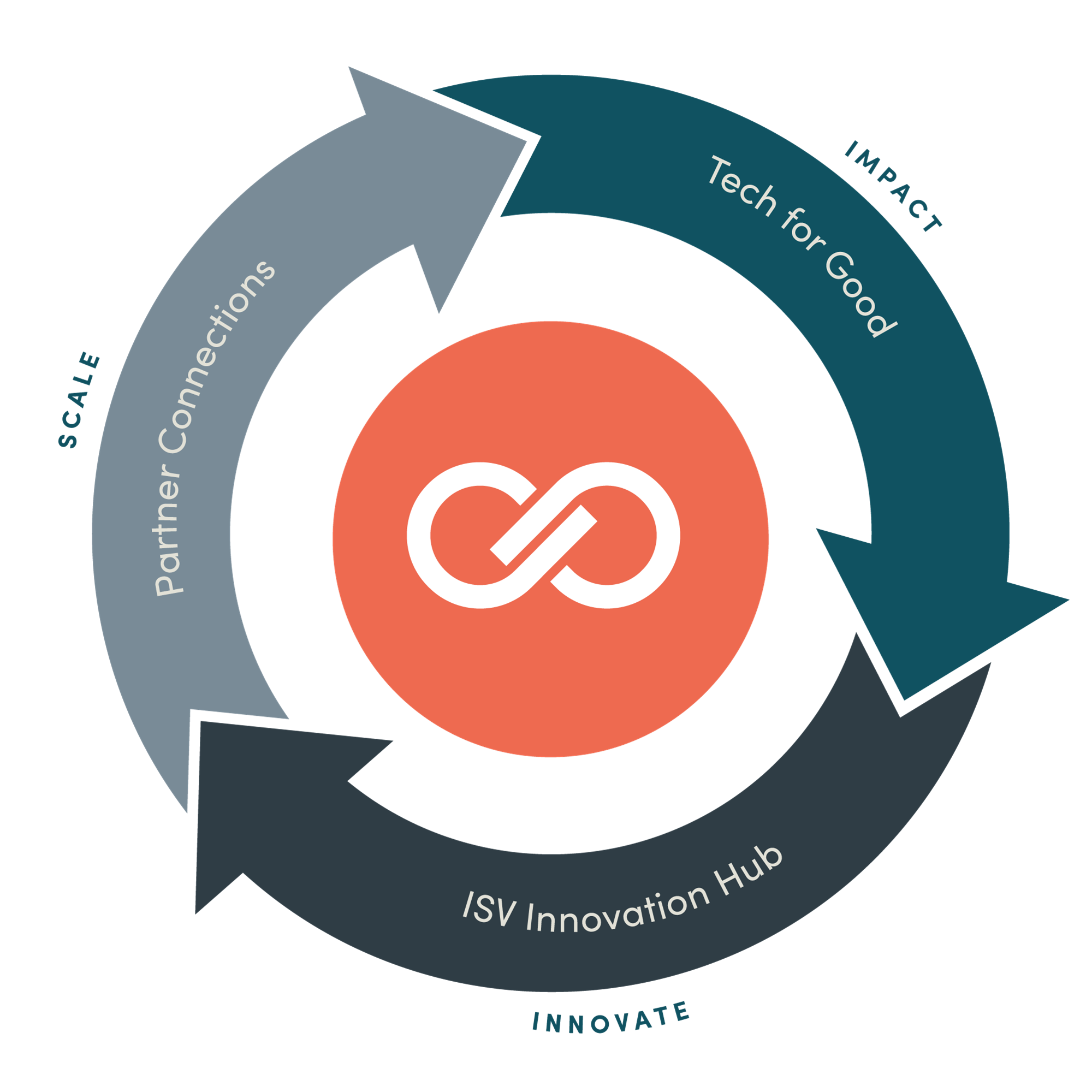
Crayon’s ecosystem approach is built around three tightly linked Channel Community programmes: the ISV Innovation Hub, Partner Connections, and Tech for Good. Each program is a distinct initiative, and together they create a connected loop in which niche innovation can scale into real-world impact.
ISV Innovation Hub
The ISV Innovation Hub is where emerging solutions, including AI workloads, vertical SaaS, edge/IoT tools, and specialist security, are shaped into products the channel can trust and sell. ISVs and partners are given an opportunity to connect and build community within the Hub, which creates opportunities to collaborate, exchange knowledge, and even build joint products and solutions to take to market.
Crayon supports ISVs with cloud readiness, marketplace onboarding across Azure, AWS, and Alibaba, pricing and packaging guidance, compliance, and enablement for co-sell motions.
Vision Group is one example: its GenAI ISV subsidiary, VisionTech was brought into the Hub, guided through marketplace listings, and personally introduced by Crayon to partners and customers across the region.
“They consistently support us in building awareness and growing in the ecosystem,” VisionTech Founder, Hui Jie, said. “Through various partner events and personal connections, Crayon has helped us amplify our brand and expand our network.”
But innovation alone doesn’t create impact. It must also reach customers.
Partner Connections
The Partner Connection Program is the distribution and delivery engine that puts ISVs and partners capability into motion. Through a structured peer-to-peer (P2P) model, Referring Partners maintain customer ownership while Premier Service Partners deliver complex workloads such as Dynamics 365, security, or data & AI. Crayon validates, matches, brokers commercial structures, supports pre-sales, and ensures governance.
This is where the intersection with the ISV Innovation Hub becomes powerful:
- Hub ISVs become differentiators inside Partner Connections projects. A grants-management ISV or AI insights engine can be bundled into a Dynamics 365 implementation delivered by a PSP.
- Partner Connections gives ISVs ready-made routes to market. Referring Partners discover them through curated introductions—not by chance. PSPs incorporate their capabilities into repeatable delivery blueprints.
- A feedback loop forms. Partners surface unmet customer needs (e.g., workflow gaps in nonprofit case management), which the Hub uses to prioritise recruitment of new ISVs.
Scale paves the way for impact and nowhere is that more tangible than in the nonprofit and public-good sector.
- Tech For Good
Tech for Good is where innovation and partner capacity are turned towards the communities that need them most. It is both the purpose lens and the real-world testing ground for Crayon’s ecosystem.
Many nonprofits in the Southeast Asia region operate under intense constraints: fluctuating funding, low cyber maturity, and limited digital skills.
Tech for Good tackles this by:
- Providing discounted or donated licensing via Microsoft Tech for Social Impact (TSI) and other vendor programs.
- Aggregating partners and ISVs into project teams aligned to specific causes.
- Framing initiatives through the pillars of Advocacy, Facilitation, Education, and Aggregation.
- Supporting partners to help nonprofits lift digital literacy and confidence, through upskilling, end-user training, and change-management practices that ensure new technology becomes usable, sustainable, and impactful.
One example of this in action is the work that HumanIT, Crayon, and vendor partners did for WEstjustice, a community legal centre that supports marginalised groups in the western suburbs of Melbourne, Australia.
By transforming their outdated systems, HumanIT was able to reduce admin overheads by 30%, client processing time by 50% and achieve a 20% increase in overall client satisfaction. “This IT transformation has been a gamechanger, it has completed shifted the way we work as a legal service and made life so much easier,” Vincent Shin, WEstjustice Program Manager, said.
Other examples of the flywheel in motion include:
- H20 Technologies, which was able to develop an amphibious vehicle called the Salamander to help with disaster response in the Pacific Islands and the Philippines
- ONGC, which was engaged by Ability First to address a growing issue in society, with people with disabilities ending up in aged care at a young age. Ability First needed ONGC to address issues with data classification, security and protection.
- AIforgood Asia partnered with Crayon to develop a proof-of-concept computer vision-based solution to help address the challenge of forest degradation and detect illegal cardamom cultivation.
Why It Matters for ISVs and Partners
For the channel, working with nonprofits and purpose-led organisations is commercially smart. The nonprofit tech market the APAC region is expanding rapidly, and there are strong incentives for partners and ISVs to participate:
- Talent, especially younger technologists, gravitates toward mission-led projects.
• Partners can build deep specialisation in high-growth domains such as security, BizApps, and data & AI.
• ISVs gain a proving ground where the value of innovation becomes unmistakably clear.
The deeper opportunity lies in what forms when these programs bring the right people together. Crayon can create the structure with the connections, the enablement pathways, and the shared purpose, but it is the human community that emerges around them that generates the real value multipliers. When ISVs, partners, and purpose-driven organisations meet around a common mission, a collective momentum builds that no single initiative could manufacture on its own. Relationships strengthen, ideas spread, and collaborations grow in directions that are often organic and well beyond the boundaries of the programs themselves.
Crayon’s role is to plant the seeds. The community carries the work forward. ISVs mature their products in ways that matter to frontline organisations. Partners build repeatable models that lift capability across entire sectors. Nonprofits gain confidence, resilience, and access to tools that help them keep serving despite uncertainty.
To learn more please visit APAC Crayon Channel



.jpg&h=142&w=230&c=1&s=1)
.jpeg&h=142&w=230&c=1&s=1)