


A strategic review of the Australian Government’s Single Seller Arrangements (SSAs) has found that while they “continue to deliver significant value”, there still exists an opportunity to strengthen their transparency and ongoing value throughout the life of the SSA.
The Digital Transformation Agency (DTA) engaged SolsticeIT to conduct the review, collecting insights from government agencies, SSA sellers, industry bodies, and both domestic and international representatives to determine if SSAs remain fit-for-purpose, continue to deliver value, and support the government’s digital transformation agenda.
Between 2019 and 2024, the SSAs achieved $1.6 billion in discounts, as well as “additional value provided” by the SSA sellers, such as the employment of more than 10,000 Australians by the SSA sellers, investment in local infrastructure and contributing to workforce capability through skills development and training initiatives.
On top of volume discounts across all buyers, greater efficiency in contracting and consistent contractual terms and conditions were also benefits that stakeholders identified in the review.
Whole-of-government arrangements were first introduced in 2009 to provide benefits and savings to the Australian Public Service through economies of scale and consistent contract terms and conditions.
These arrangements - managed by the DTA with SAP, Oracle, Microsoft, IBM, Amazon Web Services and Rimini Street - have traditionally delivered volume sourcing benefits, discounts, streamlined contracting and improved terms for security and privacy.
Opportunities for state, territory and local industry participation
Australian State and Territory stakeholders generally agreed that leveraging the Commonwealth’s SSAs makes sense to contribute to scale, access volume discounts and support a national architecture, but many said the current arrangements require additional administrative effort given they are not designed for State and Territory policy and technology requirements.
Given this, some respondents said the benefits do not always outweigh the costs of adopting future Commonwealth SSAs, so States and Territories must assess each SSA on a case-by-case basis. Nonetheless, State and Territory stakeholders indicated that they would be interested in the SSAs as long as the arrangements offer better pricing.
The review also consistently heard from both SSA sellers and buyers that there is scope to use the SSAs to improve fostering local industry participation.
While Commonwealth Australian Industry Participation Plans (CAIP) and Skills Guarantee Plans are not a mandatory requirement, their absence represents a "significant missed opportunity" to harness substantial economic benefits within Australia, the review stated.
Stakeholders responded that they saw opportunities to more clearly shape CAIP and skilling expectations of SSA sellers by requiring seller reinvestment initiatives and/or training and upskilling as a key criteria for SSA eligibility, as well as improving the time allocation and of SSA review/design to ensure adequate time is allocated to strategic co-planning of such opportunities.
Defining meaningful targets for Australian industry participation within the SSA and requiring periodic reporting against these targets to support active management by the Australian Government were also identified as a possible opportunity.
Seller lockout and standardisation identified as risks
The review found seven key risks, but identified them as low to medium risks and either already effectively managed or with some opportunity for improvement.
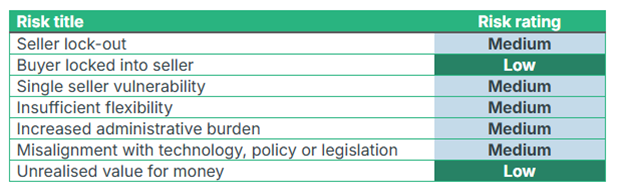
To combat seller lockout - the prevention of other sellers from competing to provide the same products, services and solutions as the SSA sellers – the review recommended maintaining competitive tension during buyers’ procurement activities by inviting multiple sellers.
In addition, it also recommended establishing CAIP Plans to support the growth of sovereign Australian industry technological capability, as well as distinguishing within the Commonwealth Procurement Rules whole of Australian Government digital contracts from Coordinated Procurements to address the risk of SSAs being utilised as a procurement pathway.
The review also identified that SSAs, due to their scale, risk becoming too standardised and hindering full utilisation of products, services and value-adds, thus lacking flexibility.
To mitigate this, the review suggested including mechanisms to enable flexible product reallocations across buyers, treating the Australian Government as a single buying entity, as well as delivering training and education to support buyers in understanding the arrangements.
Frameworks called for in review
While the review considers that SSAs remain fit-for-purpose for supporting the government’s digital transformation agenda, it did identify numerous ways to “extract further value” by strengthening their design, management and impact.
In terms of engaging with the market, the review stated there is opportunity to better leverage existing whole of government planning processes to inform emerging large-scale technology and sourcing requirements, as well as publishing a framework articulating the SSA model, its life cycle and expectations, to drive transparency of who the Australian Government want SSAs with.
Active monitoring of the market was also identified as “critical” to the identification of the ‘right’ sellers who could potentially qualify for having an SSA.
The review recommended that the DTA should publish a framework that supports clear and transparent assessment of the suitability of existing and potential SSA sellers, and reassesses the incumbent SSAs against the new framework to determine ongoing eligibility.
Ongoing work is required to monitor the market to identify any emerging need to establish SSAs in the cyber security sector, but complemented by engagement with ASD, the review identified that there is potential value in establishing capability-specific cyber security panels.
One opportunity to improve the SSAs identified by the review respondents was the possibility of consideration given to a tiered or scaled SSA model that allows smaller and newer suppliers to participate.
Current panel arrangements such as DMP2 were deemed to align with this approach.

.jpg&h=142&w=230&c=1&s=1)


.jpg&h=142&w=230&c=1&s=1)





.jpg&h=237&w=349&c=1&s=1)