.png)
Australian managed service providers are facing a massively more complex and challenging market than any time in history, and the smaller they are, the more they feel it.
Costs are rising, notably labour costs but other factors are having an impact, such as software vendors raising prices.
At the same time, economic decline means small business customers are spending less on tech, making it difficult for smaller MSPs to pass on those increased costs.
Information technologies have also evolved rapidly in recent years meaning more areas of expertise that MSPs need to either be across, or decide not to upskill in.
Larger companies offering managed services and the routine nature of first-tier support has also meant traditional services becoming commoditised, leading to a race to the bottom on price that small MSPs cannot win.
Three successful MSPs and one consultant to MSPs shared their perspectives on what it means to be profitable in 2026 in the face of these challenges.
Note: Small to medium businesses (SMBs, 1-20 employees) owner/operators often only take their salary from the business, with any surplus capital reinvested into the business. Therefore, for the purposes of this report we will consider the steps that these MSP operators are taking throughout their business operations to maximise their potential profitability.
There are some key areas where these efforts are focused, which provide the structure of this report.
These are: cybersecurity, cloud service, software as a service, industry partnerships, and automation and artificial intelligence (AI).
Automation and artificial intelligence
System and process automation has been expanding throughout the managed services world since the early 2000s, but as the MSP industry has matured, so too has the use of smarter tools to deliver services and manage customers’ IT.
Some believe the cost of these tools locked smaller MSPs out of being competitive and while that may have once been true, that’s no longer the case.
Natalia Scheidegger is the director of 3rdmill, an MSP that has been in operation since 1997. She said automation tools for MSPs have now become commoditised and therefore more readily available to smaller players.
“My theory is that (automation) is no longer going to be the remit of the larger MSPs; that smaller MSPs now have the tool kits available to actually build very sophisticated automations to serve a large number of customers at multiple sizes, except enterprise, and they’re coming for the larger players,” she said.
This speaks to a key point of how smaller MSPs are now using automation internally: to do more with less.
Rohan Milne is the founder and chief executive of Switch Connect, an MSP that is on the larger side of SMBs with just over 20 staff.
Milne said that his company dedicates resources to improving automation across business operations using both traditional process automation and, where appropriate, large language model AI tools.
He said the aim is a 50 percent increase in customers without the adding resources.
This also has the benefit of positioning Switch Connect as a highly capable partner in helping customers with automation and AI, a high-margin area of business, he added.
“As we talk to customers and sell AI, automation and BA (business automation) work to customers, we can go, ‘Hey, we've actually got a framework that works’, rather than, ‘It's a bit theoretical currently’,” he explained.
“It becomes not only a cost saving to us from a bottom line perspective, but also becomes a training and sales exercise.”
But Switch Connect may be in the minority.
Lee-ann Dias, the founder and director of a Microsoft-focused growth consultant for MSPs Sasbri Consulting, said that in her experience only a minority of MSPs are making investments like Switch Connect.
“I'd probably say one in 20 to 25 partners are probably thinking about automation and how to use AI,” she said.
However, there is a new wave of MSPs that see things very differently.
Tayler Currie is the co-founder of the two-person Salesforce-focused IT services company Accelify, which launched in 2025 and is being built from the group-up to be as automated as possible.
Agentic AI is deployed throughout the pre-sales and sales process, and the code for every project deployed for a customer is saved in an AI-ready repository.
Currie said the aim is to remain as lean and agile as possible, while operating on the level of a much larger organisation.
“Automation is the only way to compete on that level without the $300k salary costs for every specialised role," he said.
Larger MSPs and new AI-first MSPs are investing in automation,
Those that are not are likely to become outpaced and face distinctly lower profitability potential.
Cybersecurity
Cybersecurity is quickly becoming a must-have for many MSPs, particularly as margins can be relatively generous thanks to more small businesses looking for some level of cyber protection and regulation demanding compliance in certain areas across Australia.
Notably, 3rdmill is making structural changes to move from offering cybersecurity as an add-on to managed services, to a standalone product.
Scheidegger said this partially in response to the trend toward self-managed IT.
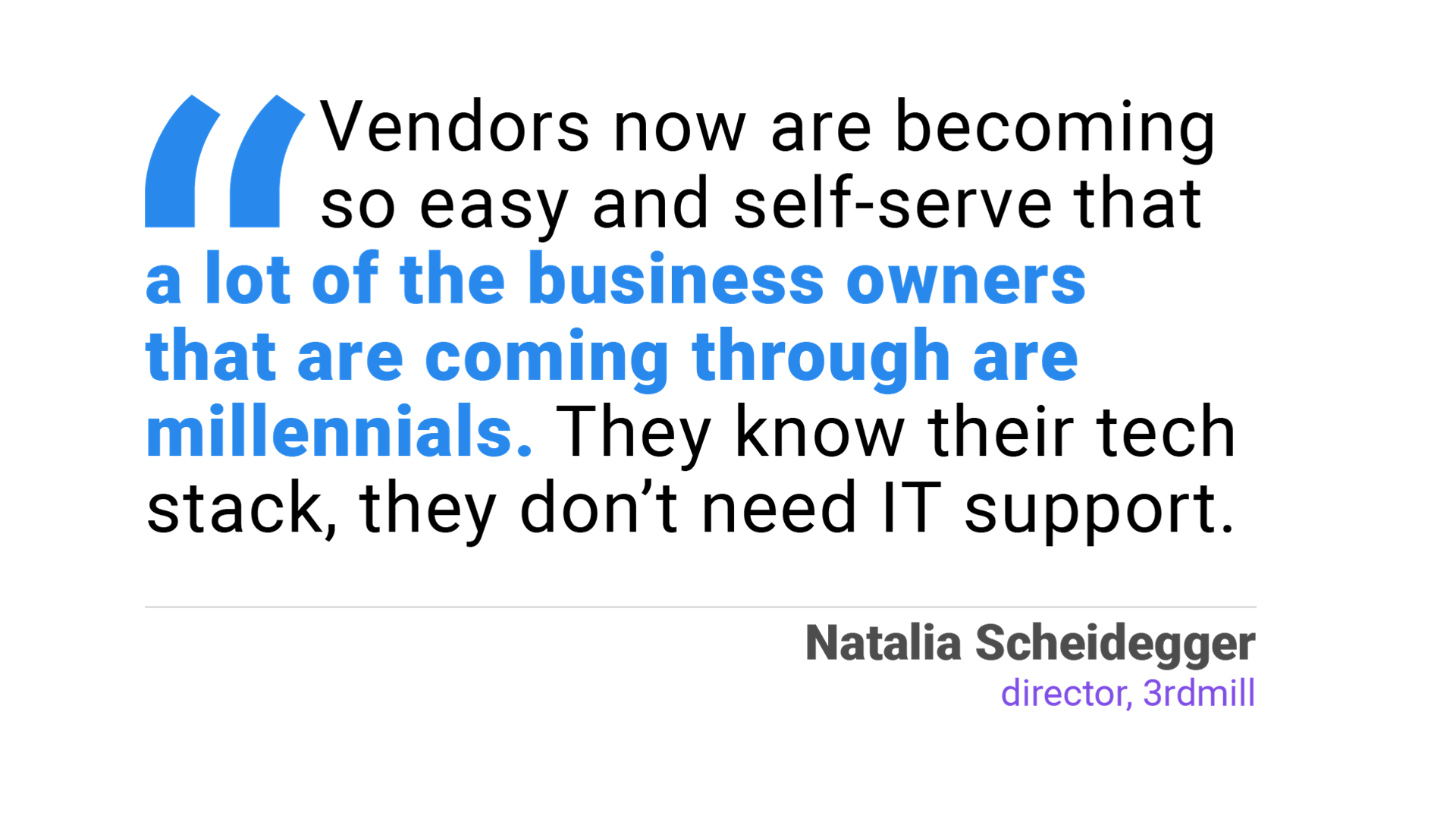
“Vendors now are becoming so easy and self-serve that a lot of the business owners that are coming through are millennials. They know their tech stack, they don't need IT support,” she said.
These customers may be looking for cybersecurity services and some minimal patching support, but not interested in wider managed services.
Scheidegger said this means cybersecurity specialist providers can end up “eating the lunch” of traditional MSPs.
“Cyber(security) only (as an offering) is critical to go to market and acquire net new customers and open your pool, but I think MSPs should also be wary of their customers questioning the value of IT support. That's where the margin can erode because those customers no longer value that,” she said.
Switch Connect also has a strong cybersecurity offering and, Milne said, had worked hard to build something unique, based on self-developed automations.
He said using third-party cybersecurity management systems is a “good place to start” but ultimately “erodes margin”.
From Dias’ view across multiple MSPs, she said too often, they were not conscientious of margin erosion.
“There's a lot of time that it takes to deploy certain security workloads and to deploy certain policies, so (MSPs) might actually charge extra for that piece of work instead of absorbing it as part of the managed services cost … but then when you look at the regulatory framework lens, that's considered more of a consultative advisory opportunity, so they put that in a different bucket,” she said.
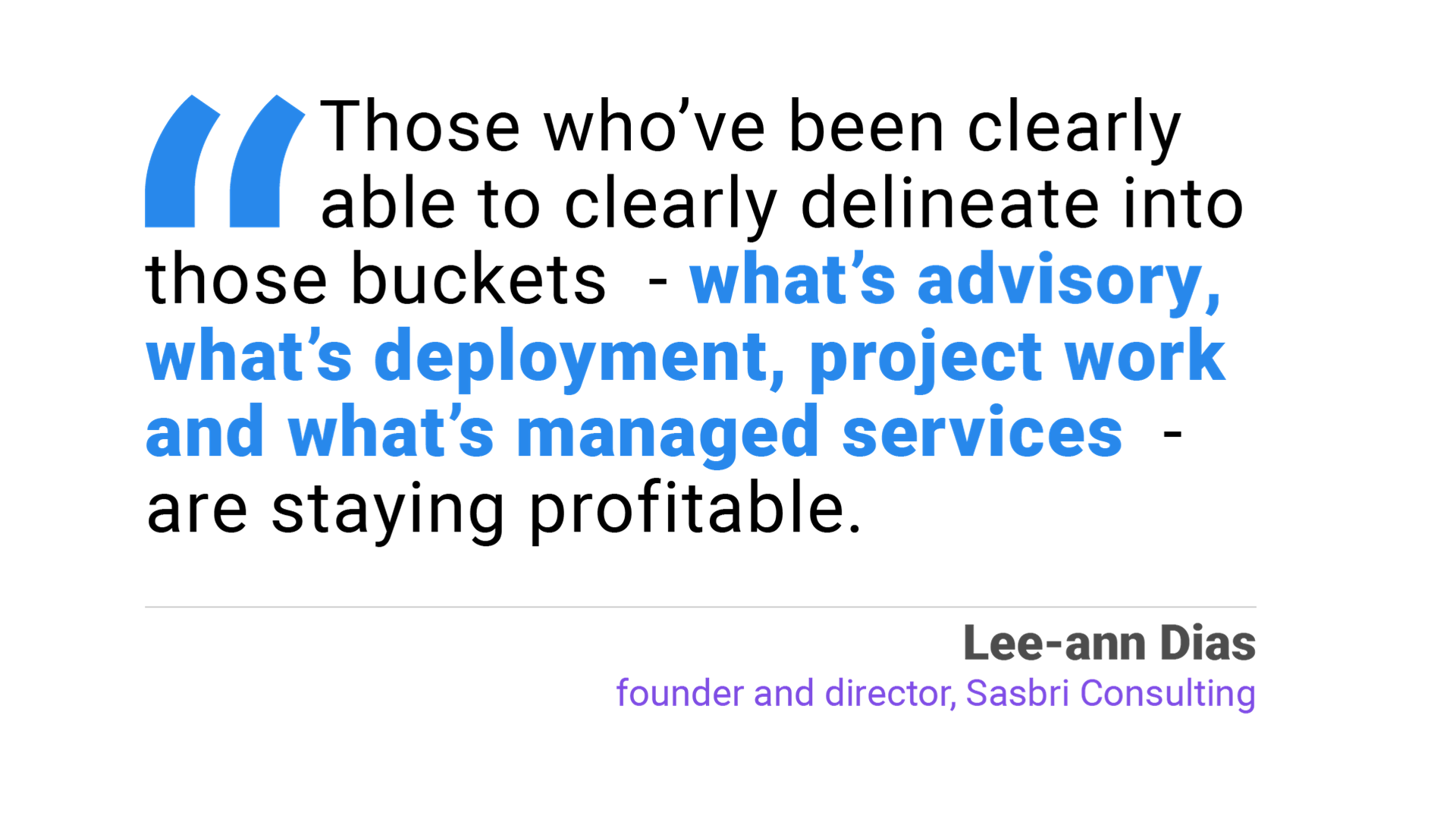
“Those who've been clearly able to clearly delineate into those buckets - what's advisory, what's deployment, project work and what's managed services - are staying profitable.”
She added that this was especially true due to the high cost of cybersecurity talent and a tendency for MSPs not to track how their time is being spent on different projects.
With greater potential profitability comes greater complexity but as more MSPs move into cybersecurity and share their knowledge with peers, the more accessible it becomes.
How this proliferation of MSPs into the area will impact margins and profitability in the long run remains to be seen.
Software-as-a-Service and licences
MSP could once turn a reasonable profit just by taking a percentage of software licence revenue, but that is no longer the case.
Milne said Switch Connect balances a commitment to a small number of vendors and alignment with the incentive demands of partner programmes with the creation of unique services, products and bundles that can be sold with a higher margin.
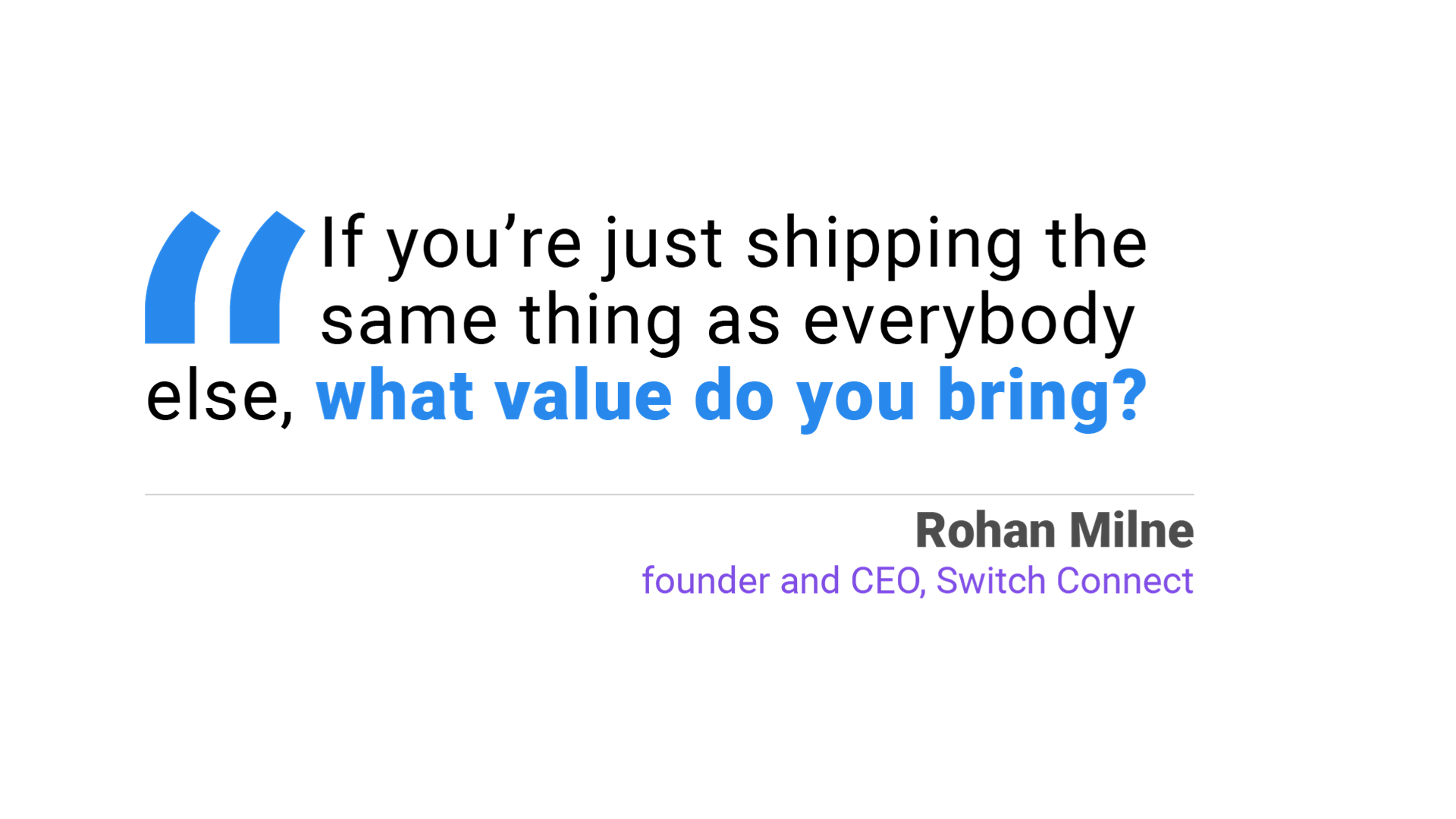
“If you're just shipping the same thing as everybody else, what value do you bring? You've got to be wrapping a managed service around everything that that you deliver, otherwise what's the point?” he said.
“How do you all bundle that together and make it super sticky? That's where the profitability is.”
Scheidegger agreed and referred back to the tech-savvy owners who are more than capable of managing their own SaaS and cloud licences.
She described this bundled service offering as a “value-add” tech stack and said 3rdmill’s approach was to consider all vendors and create unique solutions from a wide range.
Sasbri Consulting’s Dias called the bundling approach “selling outcomes” rather than products.
Currie also agreed but said Accelify is going one step further, creating “managed package” solutions for Salesforce users that can eventually be sold as SaaS-like products.
“The products that we're licencing out are very, very code heavy, so customers themselves are never going to be able to maintain it.” he said.
“When there is just a heavy amount of code, it's something that we're only going to put in a managed package to licence out so we can maintain it and update it.”
The ‘clipping the ticket’ era is well and truly over and, Dias said, SaaS licences exist only as an entry point to allow MSPs a way to sell a full package that can actually generate a profit.
Dias also reiterated her point that this means tracking time and costs against projects is now invaluable as without that data, MSPs risk charging too little and losing money where they should be making it.
Industry partnerships
The IT channel is, like many supply industries, defined by partnerships, with even the nomenclature referring to each step in the supply chain as a partner – an MSP might have vendor partners, distributor partners and then be a customer’s “trusted IT partner”.
Increasingly, peer-to-peer partnerships between MSPs have become a way of improving profitability.
Every respondent also spoke about the importance of having strategic partners that offered services that they didn’t, and vice versa.
While this idea has been around for some time, it has accelerated due to high complexity areas like data and analytics, cybersecurity, and now AI.
As an example, Milne said Switch Connect often works with Microsoft Dynamics specialists when they need to offer those services, and will offer its own Teams Calling capabilities to others.
Scheidegger said 3rdmill had similar partnerships, but raised the question if how this could change as MSPs themselves moved away from pure technical staff toward hiring more hybrid technical consultants.
“Those sorts of partnerships work because they're quite removed from the traditional MSP ecosystem. Will that kind of start to break down as we build more capability in AI and automation and bring on consultants?” she said.
Dias noted that as a consultant, she outsources her own expertise to MSPs for solutions workshops for clients, or pre-sales as a service.
Dias added that distributors have also recognised the importance of these partnerships and will act as “matchmakers” between MSPs looking to fill gaps in their capabilities.
These partnerships offer a way for smaller MSPs to take a small percentage on the white-labelled service, and the providers with extra revenue outside of their own customer base.
But perhaps more valuably, they mean that an MSP can stay focused on building out the services that best complement their current offerings to create valuable packages with better margins.
SMB MSPs are facing unprecedented challenges, but they are also some of the most nimble businesses around.
Being able to build automation and AI into systems from the ground up can greatly improve the number or scale of customers an MSP can service with limited resources.
The four participants in this report reinforce that profitability is not driven by specific products or vendors, but in the value and outcomes that MSPs offer their clients.
However, regardless of what methods an SMB MSP takes to seek profitability, one of the most important things they can do is track their time.
The discussion with the participants shows that when it comes to making money, changing nothing may be only slightly worse than doing something poorly.
But for those with the right advice, dedication and planning, there are plenty of paths that can be followed to reach profitability in 2026.