An MSP’s technology stack is essential to its functioning. But where does it fit in MSPs' plans for the future?
While it would be hard today to run an MSP without these core tools, including professional service automation (PSA) and remote monitoring and management (RMM) software, the dominance of a small number of suppliers and their close alignment in functionality means there is little room to differentiate on this base capability alone.
MSPs’ needs are evolving. If the economics of managed services are changing, are their software needs changing too?
This year’s techpartner.news MSP Index surveyed 50 Australian managed IT services partners for their perspectives on their technology stacks and how they support current and future plans, along with in-depth interviews with a dozen MSPs to bring context to their responses.
According to these MSPs, opportunity will come from the tools and capabilities layered on top of their existing stacks, often involving automation and AI capabilities. While underlying technology stacks may not be the drivers of growth, they are certainly enablers and are far from being considered inhibitors.
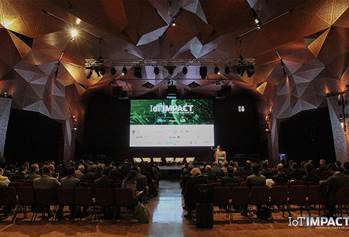
This finding was supported by the response from attendees at the 2026 techpartner.news Pipeline conference in May. When asked ‘What will be the biggest constraint on your growth over the next 2-3 years?”, about half selected talent and skills, with just three per cent nominating tooling and platform limitations.
Climbing the value ladder
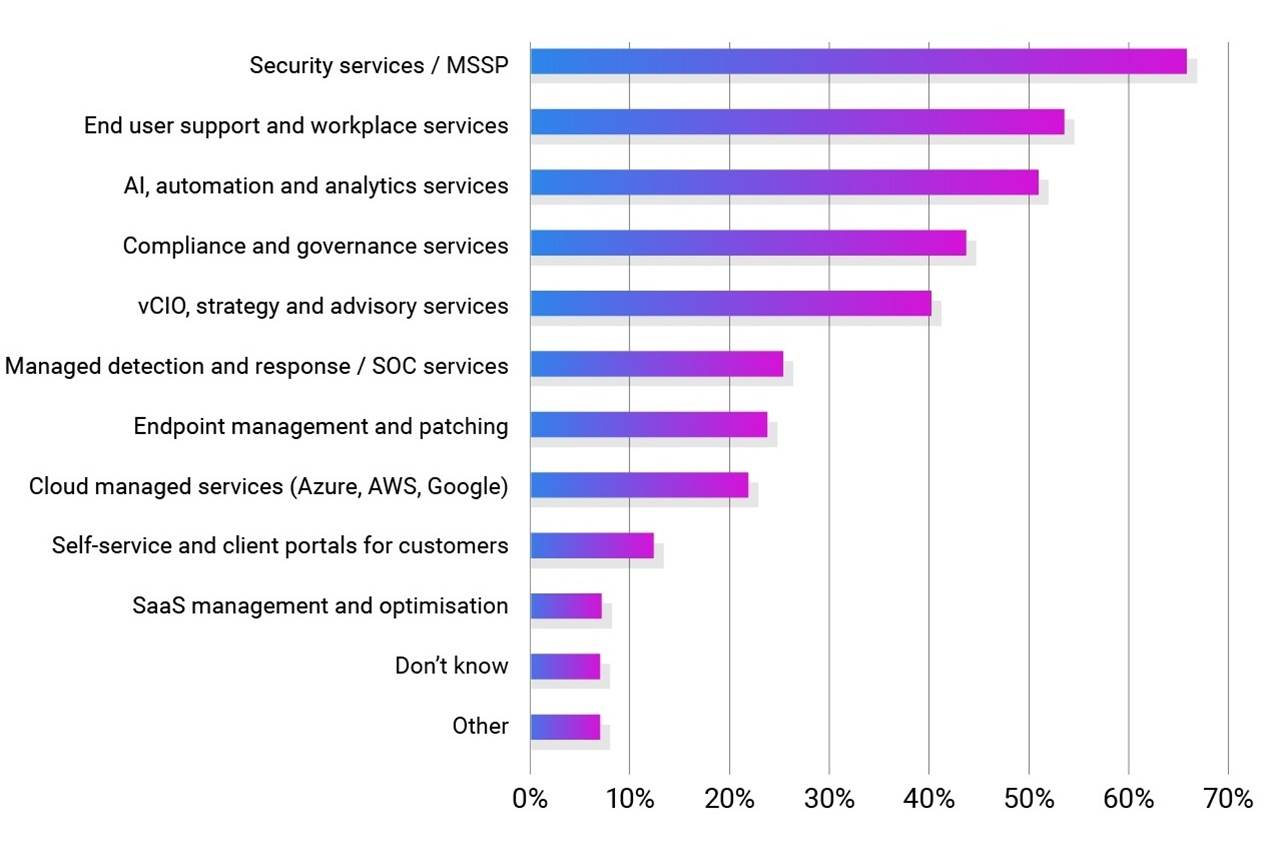
We asked MSPs: Over the next two to three years, which areas do you expect to drive most of your profit or revenue?

Summary
Respondents expected future growth to shift to higher value services, including security, AI, compliance, and advisory. They expected revenue/profit to move away from infrastructure management to services that address business risk and decision-making.
They ranked harder-to-commoditise services such as security, AI, compliance, and advisory highest as growth drivers, while ranking cloud and operational services lower – the latter appear to be maturing into lower-growth, lower-differentiation offerings.
Key points:
- MSPs saw security services/MSSP offerings as #1 profit/revenue engine
- They saw AI, automation, and analytics services as a top three profit/revenue opportunity
- Traditional IT support was expected to remain highly valuable
- Compliance and governance was expected to be a major profit/revenue driver
- Strategic advisory services were expected to be a key driver
Recommendations:
- Invest in cybersecurity capabilities
- Build commercially viable AI offerings
- Strengthen advisory-led engagement models
- Differentiate through business outcomes
- Protect core services while repositioning them
Supporting tools
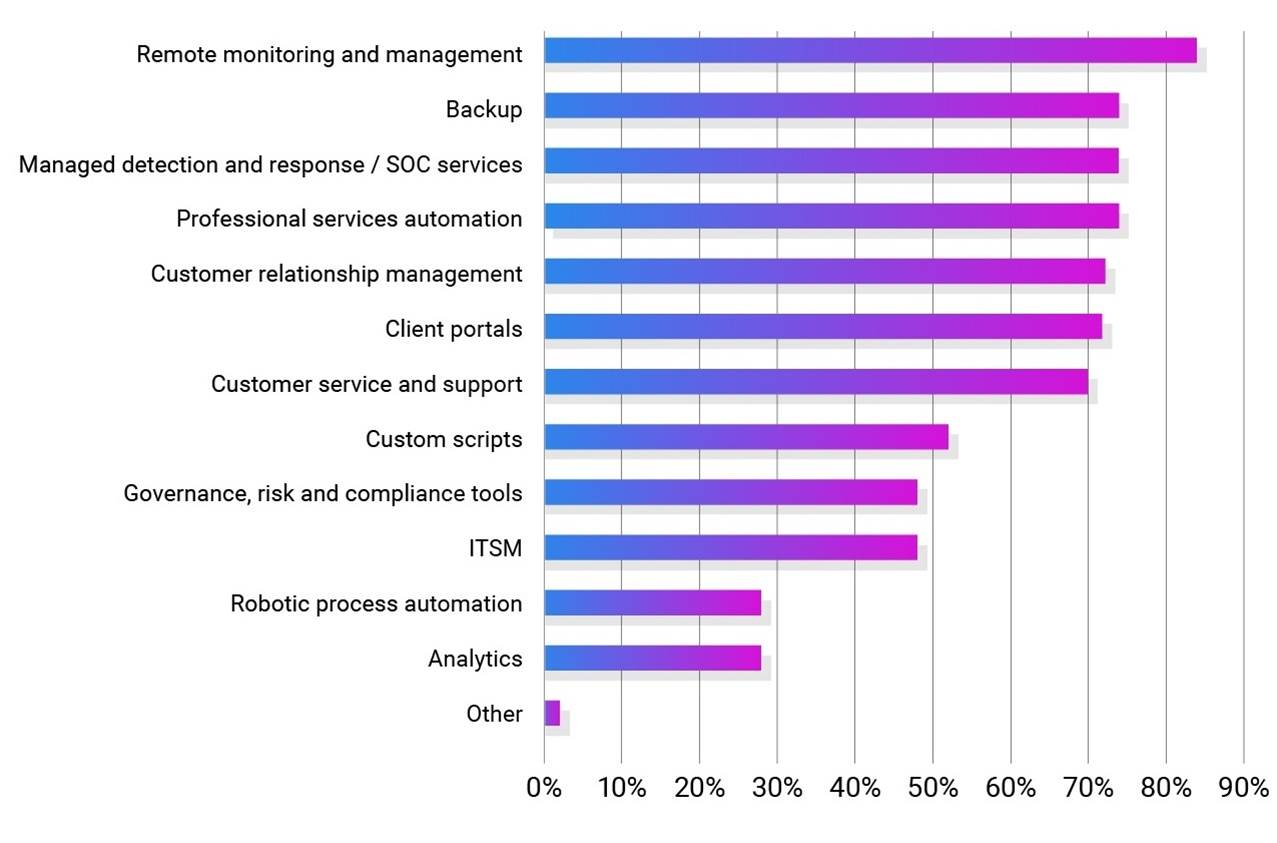
We asked MSPs: What systems and tools are you currently using to support your operations?
Summary
As expected, the responses are a reminder that core MSP operational platforms have become largely standardised across the market. But while service delivery tooling is well established, use of supporting capabilities such as automation, analytics, governance, and customer engagement tools is more varied. Competitive advantage is likely increasingly determined by how providers integrate, optimise, and extend their platforms rather than the platforms themselves.
Key points:
- Differentiation is shifting above the platform layer
- Data and automation remain underutilised strategic assets
- Execution is arguably becoming more important than technology selection
- Optimisation is overtaking platform expansion as a growth driver
- Insight generation is emerging as a key differentiator
Recommendations:
- Prioritise analytics capabilities over additional operational tools
- Expand automation and integration capabilities
- Evaluate technology investments through a business outcomes lens
- Strengthen governance and risk management capabilities
- Develop intelligence-led services alongside operational offerings
Platform confidence
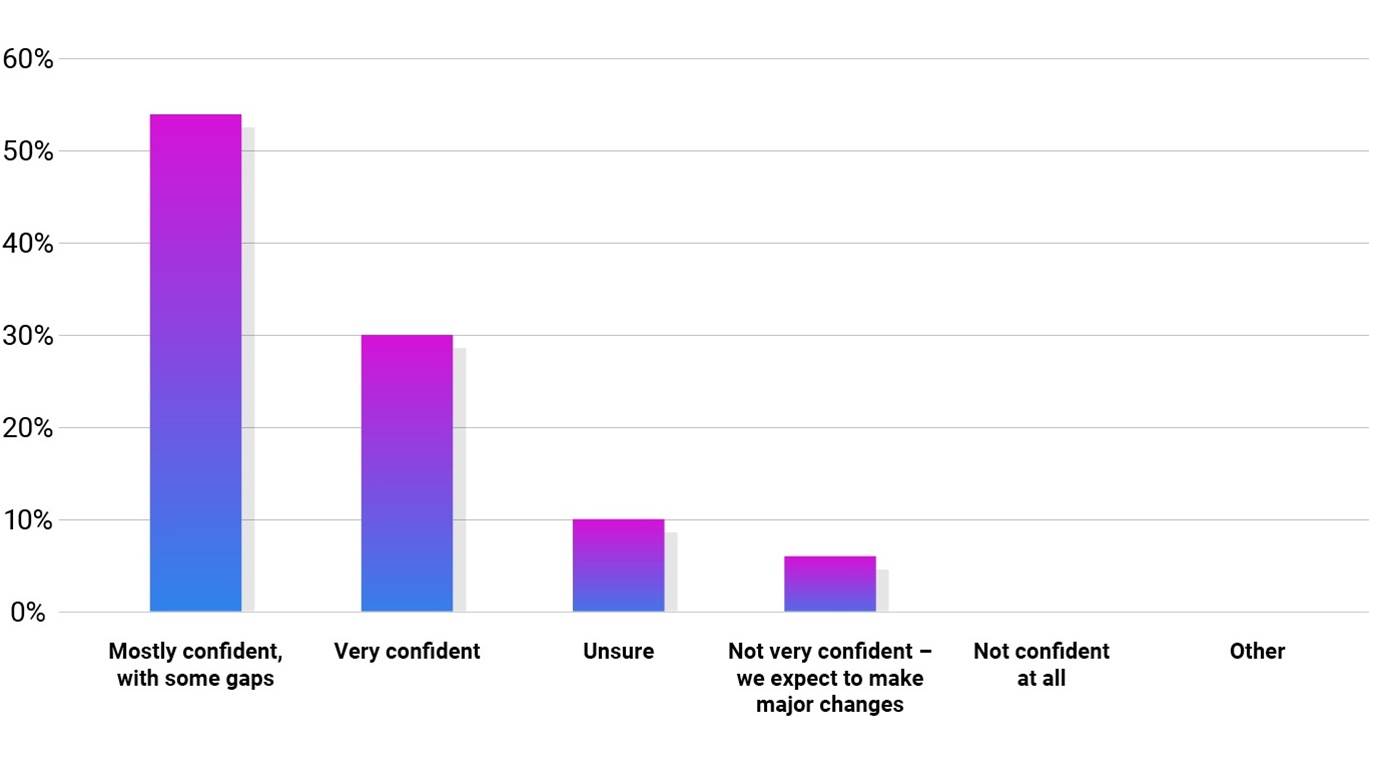
We asked: How confident are you that your current core MSP software stack will still be the right foundation for your business in three years’ time?
Summary
Despite significant technological change, MSPs we surveyed were not anticipating widespread platform disruption. It appears that competitive advantage exists not within core tooling, but comes from how effectively MSPs leverage, integrate, and extend existing platforms. As confidence grows in the maturity of the MSP software ecosystem, future success is likely to be a matter of capability, rather than a technology replacement.
Key Points:
- Confidence outweighs expectations of major platform change
- Evolution appears more likely than disruption
- Capability gaps are acknowledged
- Core platforms remain strategically relevant
- Integration and optimisation remain key
Recommendations:
- Consider addressing platform gaps rather than pursuing replacements
- Evaluate AI readiness within existing platforms
- Reduce complexity through tool rationalisation
- Develop a long-term platform roadmap
- Prioritise flexibility when making tool investment decisions
Hardest working tools
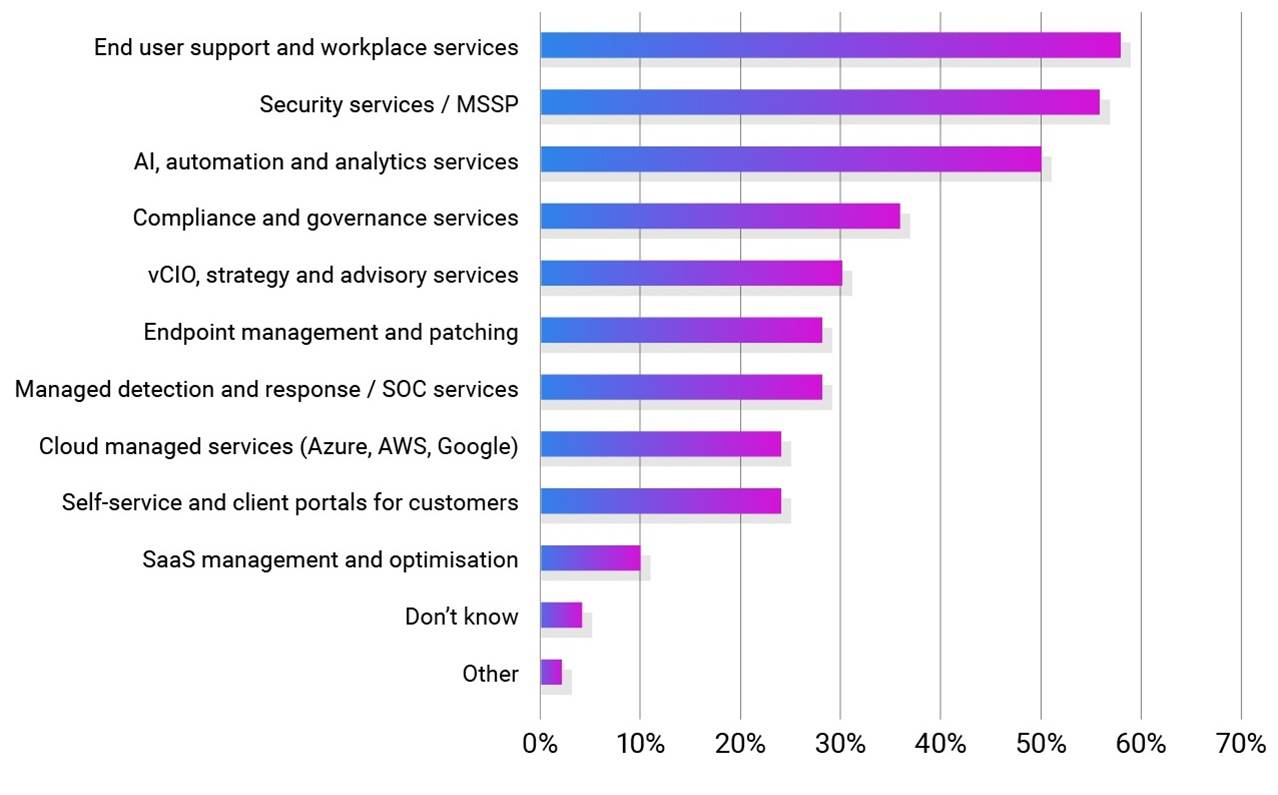
We asked MSPs: Over the next two to three years, which areas do you expect will require the most day-to-day work from your team and your software tools and systems?
Summary
The responses indicate that these MSPs will remain structurally dependent on labour-intensive services. However, future success may depend less on winning new opportunities and more on reducing the operational effort required to support them. The MSPs most likely to outperform will be those that successfully decouple revenue growth from workforce growth and use automation, standardisation, and AI to generate more revenue without a corresponding increase in effort.
Key Points:
- Revenue scalability remains an unresolved industry challenge
- Labour dependency continues to constrain growth potential
- Productivity gains will become increasingly important
- Operational leverage will separate market leaders
- Service model transformation may lag market evolution
Recommendations:
- Reduce reliance on manual service delivery
- Redesign services for scale, not just growth
- Embed automation into core operating processes
- Measure revenue growth against productivity improvements
- Prioritise operational leverage in investment decisions
Automation expectations
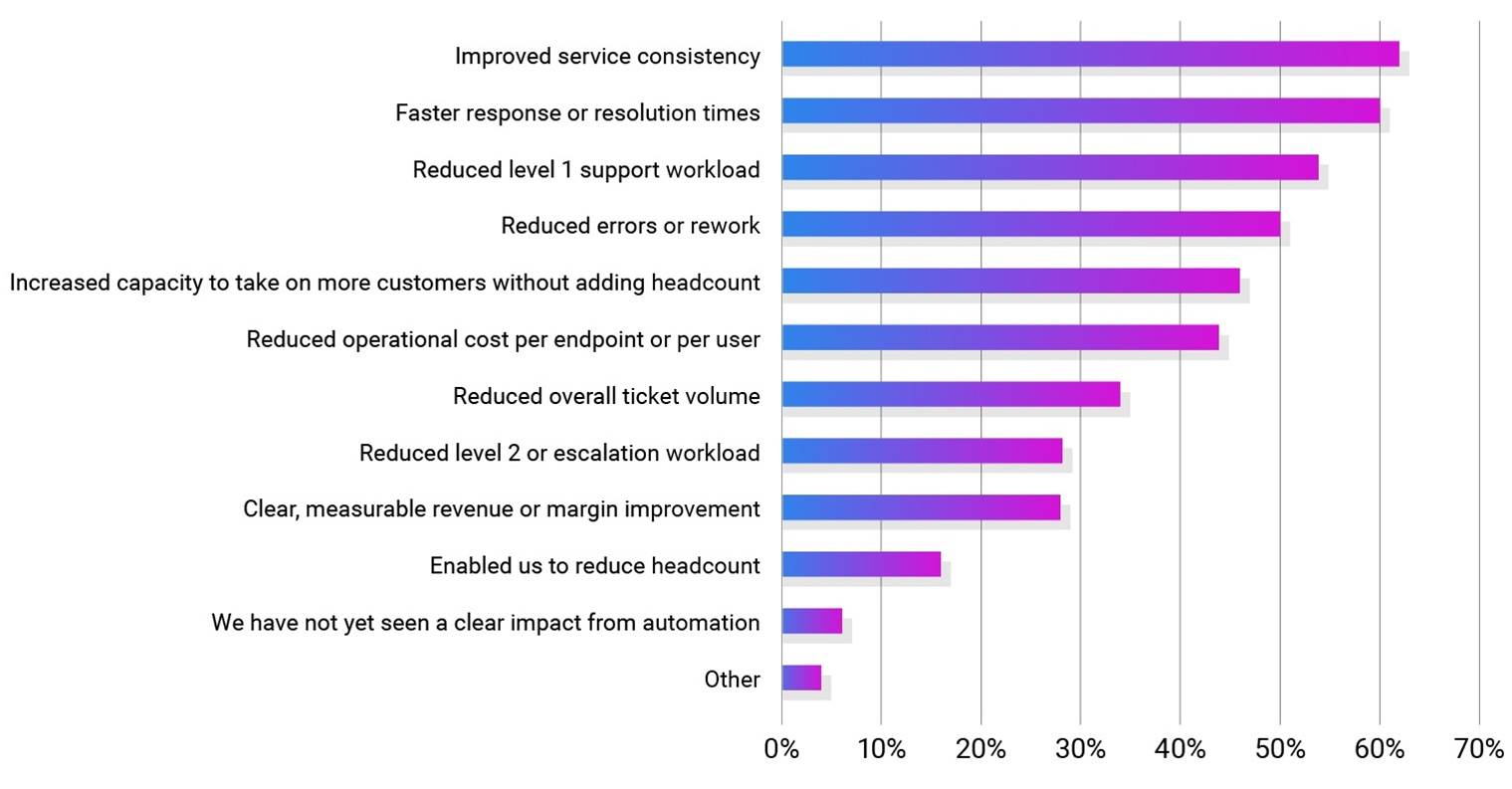
Our survey asked: Thinking about the automation you have in place today, where have you seen the most impact so far?
Summary
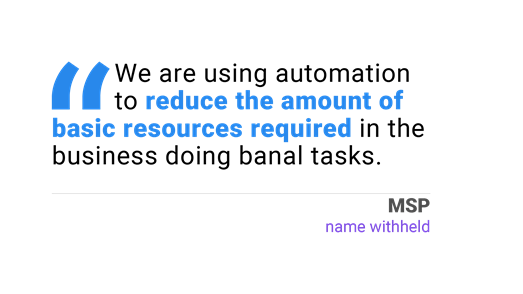
MSPs recognised the need to scale, automate, and evolve their service models, yet many were still capturing automation's immediate operational benefits rather than its full economic value. While this might deliver short term margin relief, it presents the danger of automation becoming a race to the bottom should clients seeks to claw back spending. The next stage of maturity will come from using automation to fundamentally change how work is delivered.
Key Points:
- Automation benefits were primarily operational, not commercial
- Automation maturity remained largely tactical
- Efficiency gains were not fully monetised
- Service quality improvements exceeded financial outcomes
- Scalability opportunities remained underexploited
Recommendations:
- Link automation initiatives to financial metrics
- Prioritise automation that improves scalability
- Measure margin impact alongside operational benefits
- Reinvest efficiency gains into growth areas
- Shift from task automation to process transformation
Automated margin squeeze
We asked: Are you concerned that the introduction of automation by yourself and your competitors will lead to downward pressure on prices?
Summary
MSPs were more optimistic about automation's value than concerned about its impact on pricing, despite reporting that automation is primarily delivering operational benefits rather than measurable commercial gains. This suggests they may believe there is still substantial untapped value to capture from automation before commoditisation becomes a serious threat. However, if automation remains focused on efficiency improvements rather than creating new client value, those gains may become expected by customers and absorbed into pricing.
Key Points:
- Automation was not widely viewed as a pricing threat
- Confidence in value creation was high
- Differentiation appeared stronger than commoditisation fears
- Providers expected to retain automation-driven value
- Market sentiment remained notably optimistic
Recommendations:
- Focus automation on client outcomes, not cost reduction
- Build differentiated services around automation capabilities
- Measure value delivered, not effort reduced
- Strengthen pricing models around business outcomes
- Avoid competing solely on operational efficiency
Responding to pricing pressure
We asked: How do you propose to maintain or improve revenue in the face of downward pressure on pricing?
Key Findings:
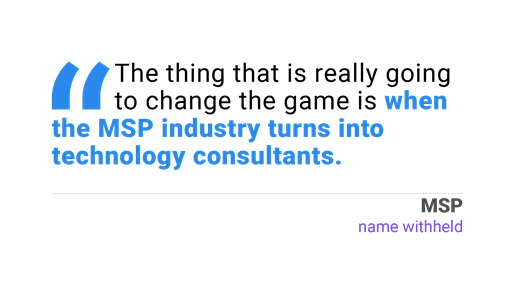
MSPs were responding to pricing pressure by expanding into higher-value services. Many believed core managed services were becoming commoditised. They saw revenue growth coming from:
- Advisory services (vCIO, strategic consulting)
- Compliance services
- Security services
- AI-related offerings
- Additional value-added services
Demonstrating business outcomes was becoming a critical competitive differentiator. MSPs told us they believed that measurable business value was essential for maintaining pricing power and customer loyalty. They were focused on:
- Showing value
- Communicating business outcomes
- Building trust
- Understanding customer needs
- Differentiating from competitors
Automation and AI were viewed as the primary margin-protection strategy. Automation was expected to protect margins and free capacity for higher-value work – not replace revenue – through:
- Streamlining operations
- AI-first approaches
- Using efficiency gains to deliver additional services
Growth was expected to come from better-fit and more complex clients. MSPs were increasingly targeting larger, more complex, and better-aligned customers where differentiation and value-based pricing are easier to sustain, achieved via:
- Larger clients
- More complex engagements
- Stronger ideal customer profile alignment
- Expanding existing accounts
Three-year forecast
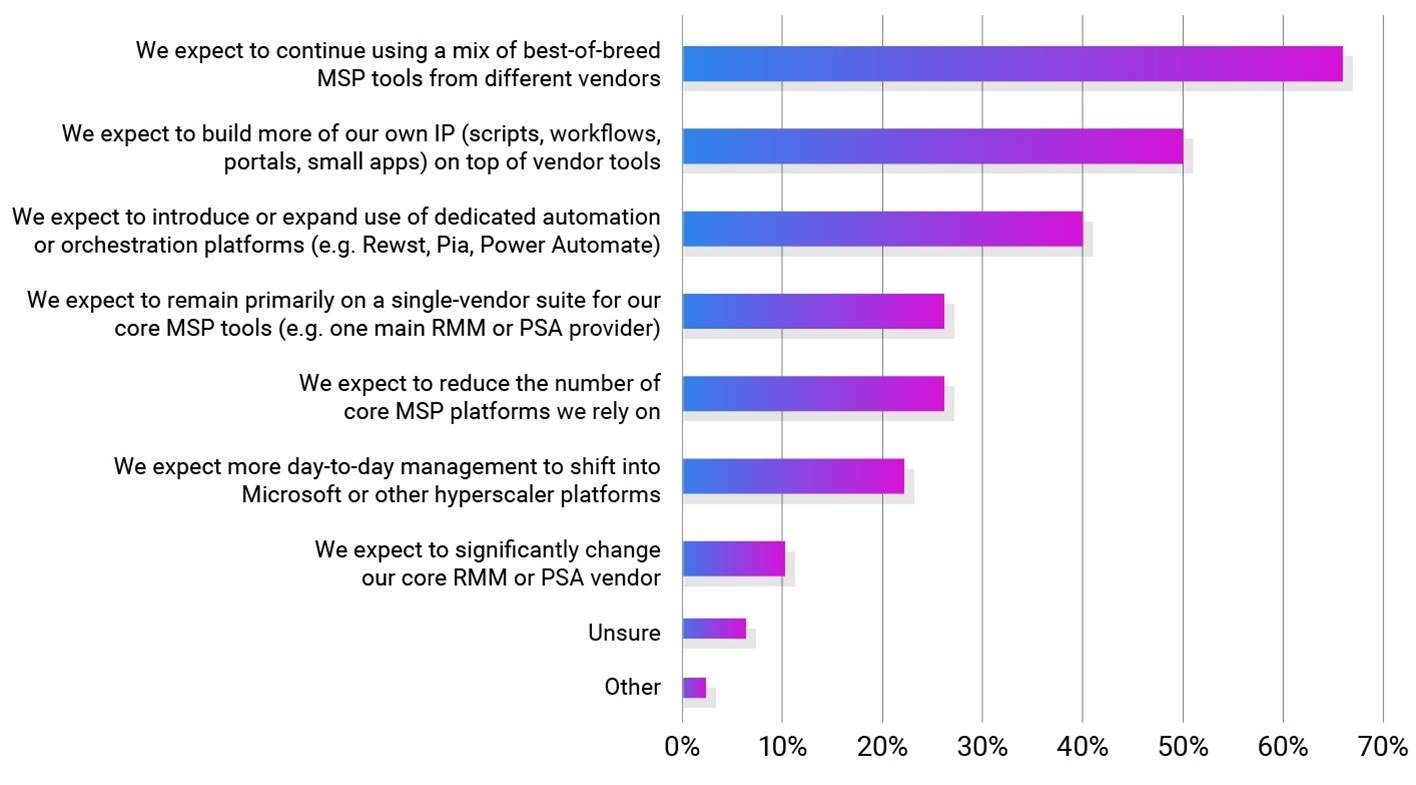
We asked: Thinking about your core MSP tools over the next three years, which of the following statements apply to your organisation?
Summary
MSPs largely trusted their existing platforms, expected limited vendor disruption, and were not planning major stack replacements.
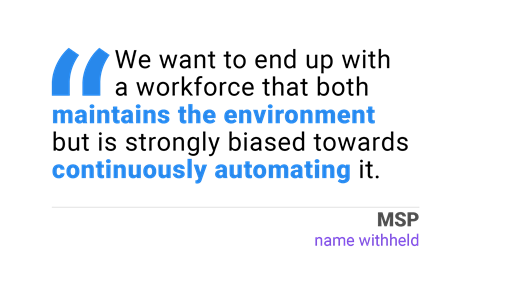
Despite talk of consolidation, they indicated that the future MSP technology stack will be more customised, automated and interconnected. Competitive advantage appears to be shifting from ownership to orchestration, with MSPs building unique operating capabilities on increasingly common technology foundations.
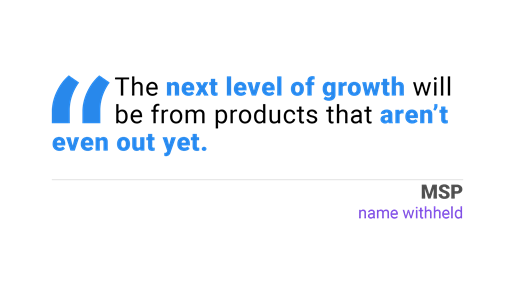
Value creation seems to be moving from selecting the right tools to designing the processes, automations, and intellectual property that sit on top of them.
Key Points:
- Differentiation is moving above the platform layer
- Proprietary IP is becoming a strategic asset
- Automation is evolving beyond native platform capabilities
- Platform replacement appetite was relatively low
- MSPs favoured orchestration over consolidation
Recommendations:
- Build capabilities beyond vendor-native functionality
- Invest in proprietary workflows and automation assets
- Treat automation IP as a competitive differentiator
- Balance standardisation with strategic customisation
- Prioritise flexibility in purchasing decisions
Customer self service
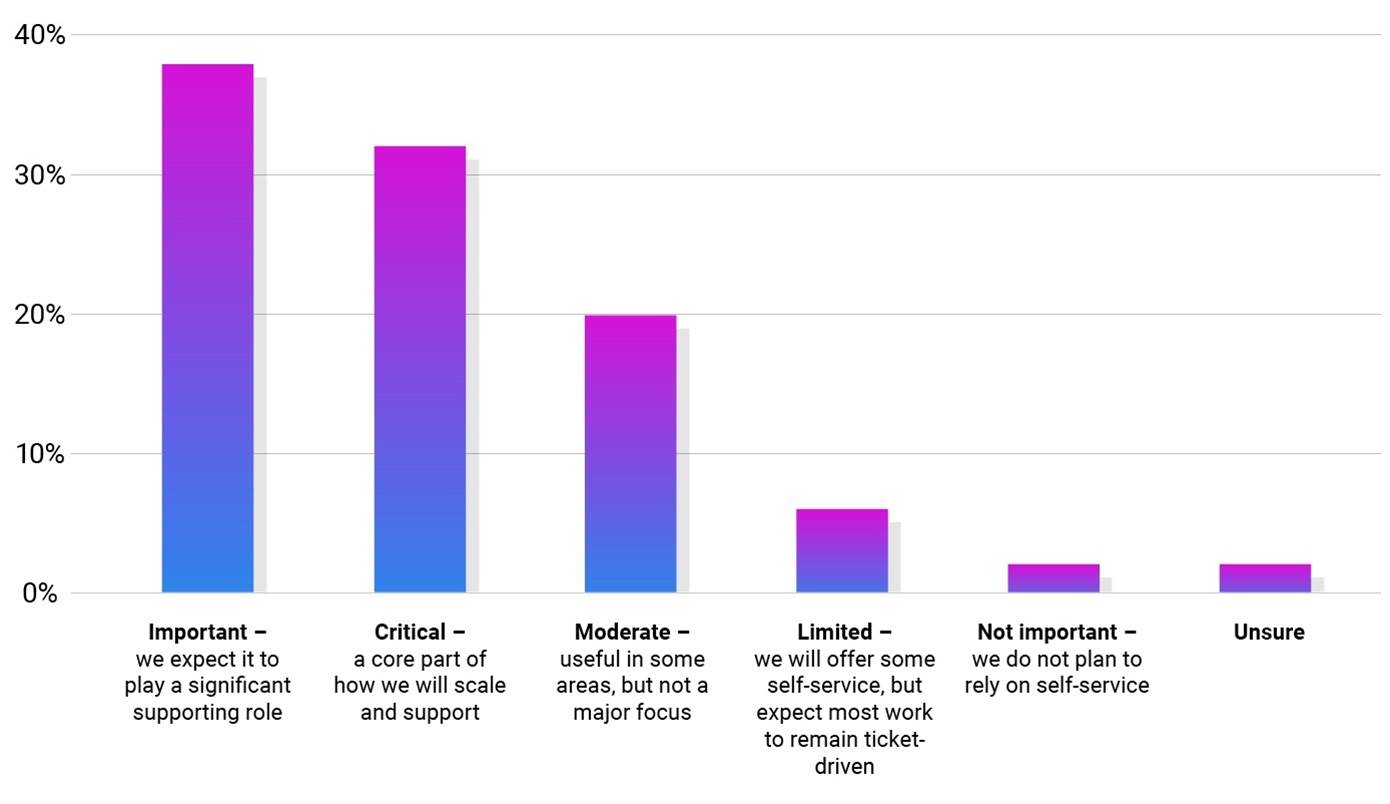
We asked: How important do you expect customer self-service to be in your service model over the next two to three years?
Summary
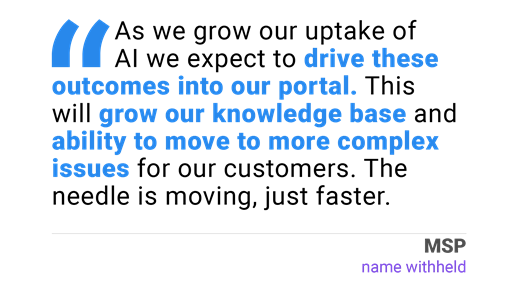
Traditional ticket-driven support models are difficult to scale, particularly as MSPs pursue growth in more complex, higher-value services. Self-service is emerging as a mechanism for creating operational leverage, allowing providers to redirect human expertise toward activities that drive greater client and business value. Future growth cannot rely solely on adding people, but MSPs can redesign service delivery around the principle that human intervention should become the exception rather than the default.
Key Points:
- Respndents indicated that self-service will become an enabler of scalability
- Ticket-driven models face increasing economic pressure
- Human expertise is shifting toward higher-value work
- Service models are becoming increasingly digital-first
Recommendations:
- Automate high-volume, low-value customer requests
- Reserve specialist resources for complex engagements
- Measure self-service adoption and deflection rates
- Position self-service as a customer experience improvement
Role of AI
We asked: What role do you see AI playing in your internal operational and customer systems?
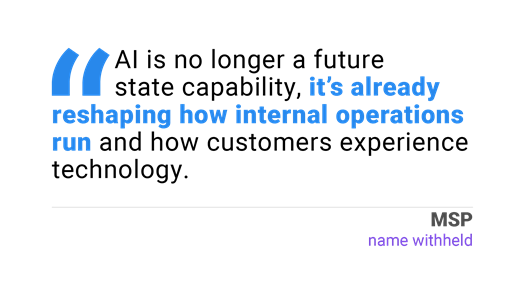
AI appears to be moving from experimental technology to a core operational capability. The primary focus is on automating service desk operations, improving efficiency, enhancing knowledge access and scaling service delivery.
Most survey respondents viewed AI as a tool that augments technical teams rather than replaces them, with the greatest customer benefits expected through faster, more proactive, and higher-quality service delivery.
Human oversight remains important, but there was consensus that AI would become fundamental to MSP operations over the next 1–2 years.
Finding 1: MSPs overwhelmingly viewed AI's primary role as improving operational efficiency rather than creating entirely new business models. It was viewed as useful for:
- Improving productivity across technical and operational teams
- Automating repetitive and low-value administrative tasks
- Reducing manual effort and operational overhead
- Enabling MSPs to scale service delivery without proportional increases in headcount
- Improving consistency, quality, and speed of service delivery
Finding 2: The service desk is emerging as the primary deployment area for AI, where it is best suited to:
- Automating Level 1 support activities
- Improving ticket triage, categorisation, and routing
- Accelerating ticket resolution through knowledge base recommendations
- Assisting engineers with troubleshooting and documentation
- Enhancing response times and customer support quality
Finding 3: Most MSPs saw AI augmenting employee capabilities and improving decision-making rather than fully replacing technical staff, with key roles in:
- Acting as a digital assistant or "second pair of eyes" for engineers
- Supporting decision-making with faster access to information and insights
- Allowing technical staff to focus on higher-value and more complex work
- Improving employee effectiveness and service quality
- Maintaining human oversight and customer relationships while automating routine activities
AI and the customer
We asked: What role do you see AI playing in your customer facing systems?
Summary
MSPs saw AI's customer-facing role as improving support experiences through self-service, triage automation and faster access to information, while preserving human engagement for higher-value interactions. It was viewed as an enabler of more responsive, scalable and proactive customer service rather than a complete replacement for human support.
Finding 1: AI is expected to become the primary mechanism for delivering scalable self-service support and handling routine customer enquiries, via:
- AI-powered chatbots and virtual agents
- Self-service support capabilities
- 24/7 first-line support for common customer requests
- Faster issue resolution without requiring human intervention
Finding 2: AI is expected to become the first point of contact for customer support, managing triage, routing and resolution of simple issues, providing:
- Automated Level 1 support
- Ticket triage and categorisation
- Suggesting resolutions to common issues
- Routing and escalation management
Finding 3: AI is expected to improve customer experience by providing instant access to organisational knowledge and support information, such as through:
- Knowledge base powered chatbots
- Customer-facing knowledge discovery
- AI-generated recommendations and suggestions
- Reduced wait times for common enquiries
Finding 4: AI is expected to enhance the customer experience through faster, more responsive, and more personalised service interactions, leading to:
- More proactive support experiences
- Better customer outcomes
- Improved service quality and consistency
- Happier and more loyal customers
Finding 5: MSPs expected that automating routine customer interactions would allow technical teams to focus on higher-value and more complex work, by:
- Resolving simple issues without human intervention
- Handling repetitive support tasks
- Freeing engineers to focus on complex problems
- Improving service efficiency
Organising for the future
We asked: Looking ahead two to three years, what is the biggest change you expect to make in how you organise your tools and automation?
Summary
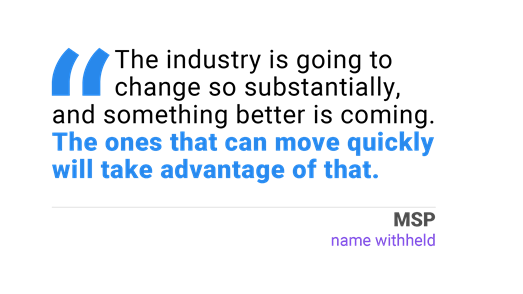
Over the next two to three years, MSPs we surveyed told us they expected their biggest organisational change to be the integration of AI and automation into core business processes, supported by simplified technology stacks, stronger governance and workforce transformation.
They expect emphasis less on acquiring new tools and more on redesigning operating models to enable scalable, efficient, and AI-augmented service delivery. Key outcomes may include:
- Fewer core platforms but more custom workflows, integrations and automation layered on top
- AI and automation embedded into core operational workflows
- Greater focus on governance, ROI and disciplined AI adoption
- AI augmenting rather than replacing employees
- A shift from tool-centric operations to process-centric automation
Conclusion: A common stack, an unclear path to greater value
The technology stack is the foundation of a modern MSP. The contributors to this year's MSP Index demonstrate a willingness to continue investing heavily in those foundations, with remote monitoring and management (RMM), professional services automation (PSA), backup, security, and automation providing the essential concrete and rebar.
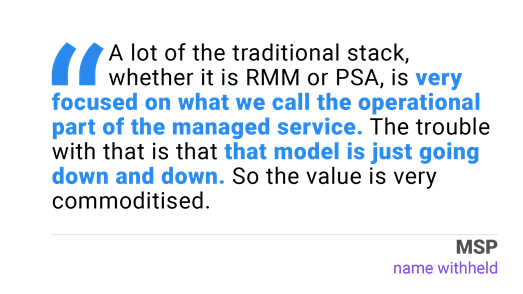
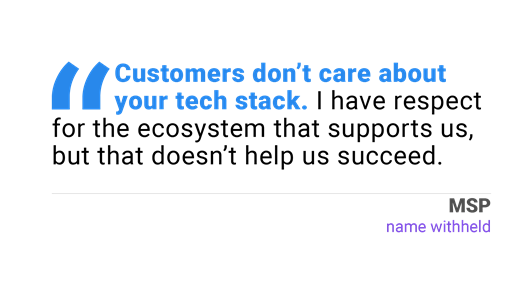
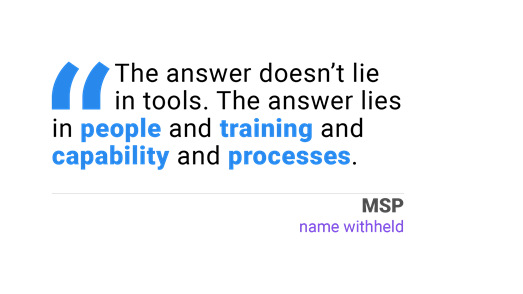
Yet with many MSPs recognising that they are competing in a sea of sameness, the widespread adoption of these tools suggests that many MSPs are pursuing similar growth opportunities, with technology alone becoming a less meaningful source of differentiation. As one respondent observed:
Security competition
If more fertile territory exists, MSPs appear divided on where it might be and how to reach it.
Security emerged as the most commonly cited growth opportunity, but its popularity raises the prospect that it too could become a crowded and increasingly commoditised market unless providers continue to elevate their capabilities. As one MSSP pointed out:
"Every MSP will say they will keep you cyber secure, but thousands of organisations are still suffering cyber security attacks in Australia each year, and almost all of them have MSPs."
Race to the bottom?
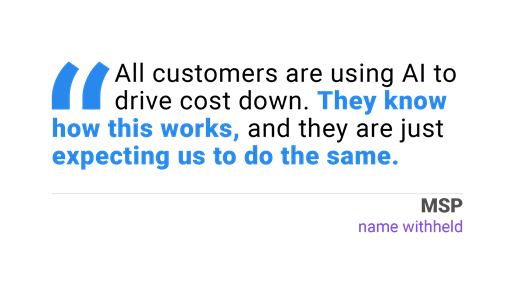
For many MSPs, automation and AI represent a natural response as tools for both reducing the cost of existing services and as platforms for creating new ones. However, the responses suggest that many MSPs are feeling pressure to use AI primarily for cost reduction, creating the potential for a race to the bottom if those technologies are not also used to create new forms of value. As one MSP noted:
"All customers are using AI to drive cost down. They know how this works, and they are just expecting us to do the same. So there is a downward pressure already on that operational part of the managed service to just be as cheap as possible, and you are going to have to use these tools to stay in market."
While many MSPs acknowledge this risk, that awareness has yet to translate into clearly defined strategies for using AI to create new value.
Primed to leapfrog
The pathways forward may not yet be clear, and many MSPs are only beginning their journeys.
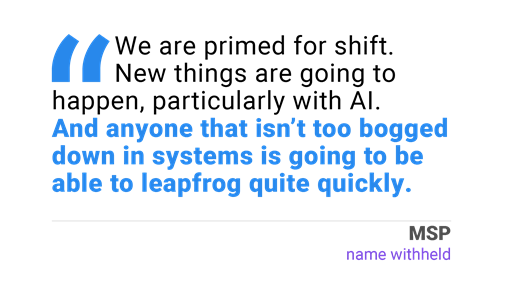
What is becoming increasingly clear, however, is the need for change. For many future-focused MSPs, that future appears to be built less around technology itself and more around delivering services that customers genuinely value, understanding customer needs and demonstrating business outcomes through providing advisory services and strategic consulting.
Many MSPs already hold a trusted relationship – now is the time to capitalise on it.
Investments should prioritise flexibility, support future AI capabilities, strengthen security expertise, and create opportunities to capture and leverage proprietary knowledge. AI should be viewed as a growth enabler, not simply as a mechanism for reducing headcount or driving costs lower.
In the next phase of the MSP market, the winners are unlikely to be defined by the tools they use – they will be defined by what they build on top of them.
Contribute your view to our reporting on MSP software by taking our latest MSP Index survey. The survey should take approximately 10 mins and answers will be used anonymously to inform our reporting.
Let us know about an MSP topic you want us to report on, by contacting our editorial team here.