
The supply chain shift no one can ignore
Not long ago, marketplaces were treated as a transactional afterthought, a cleaner way to process deals already done. Now they’re quietly reshaping the economics of the channel.
According to Omdia APAC channels chief analyst, Mark Iles, what began as a hyperscaler experiment has evolved into something far more structural: a fundamental shift in how technology goods and services move from vendor to customer.
“We’ve had the most convoluted supply chain of almost any industry,” Iles said.
“It’s 2026. We should have figured out a better way to buy and sell technology by now.”
Iles points to three distinct marketplace models — hyperscaler, distributor and independent third-party — with most momentum today sitting with hyperscalers, even as the others begin to evolve. Cybersecurity is emerging as the dominant category, driven by strong demand and the SaaS-based nature of many security solutions.
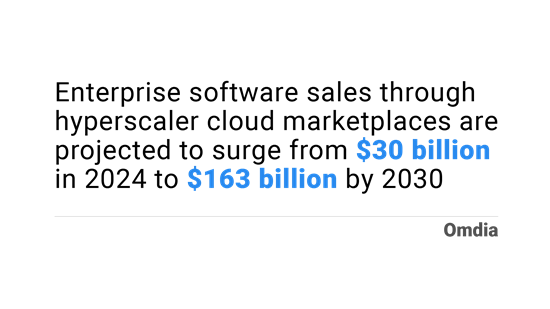
New research from Omdia has revealed that enterprise software sales through hyperscaler cloud marketplaces - led by AWS, Microsoft, and Google Cloud - are projected to surge from $30 billion in 2024 to $163 billion by 2030.
For channel partners, the upside is clear. Marketplaces simplify procurement, accelerate deals and unlock access to pre-committed cloud spend, while reducing the administrative burden of transacting.
They also create new ways to package value - combining software, services and managed offerings into outcome-based engagements - and open the door to new markets, customers and partner-to-partner models.
Just as importantly, they align partners to hyperscaler sales motions, unlocking committed cloud spend, accelerating deal cycles, and opening up new co-sell opportunities.
But most partners, Iles warned, are still lagging behind the shift.
“Whenever I talk to partners about it, the majority are remarkably on the back foot,” Iles said.
At the heart of that shift is the customer.
“Water runs downhill; it takes the path of least resistance,” Iles said.
“If there’s an easier way for customers to procure goods and services, and it has less friction, that’s where they’re going to go.”
Which means, whether partners are ready or not, marketplace adoption will ultimately be driven by customer demand.
For now, marketplaces remain primarily transaction engines, simplifying how deals get done, rather than acting as true discovery or go-to-market platforms.
“If you’re transacting something, they’re brilliant,” Iles said.
But when it comes to discovery, the experience is still lacking.
Indeed, that distinction matters for partners weighing investment. The industry often talks about marketplace as a route to market, but the bigger question is whether it can evolve into a true go-to-market engine, Iles said.
The partner gap
Despite the scale of committed spend and clear customer pull, many partners are still catching up.
Across the ecosystem, marketplace is often still treated as a future conversation rather than a present reality.
Part of the challenge is distraction — from cloud, from AI, from the next big shift — while the commercial model underneath continues to change.
Iles advice? To simply get involved.
“You need to be in the game,” he said.
“Even if you don’t sell anything at first, you’ll learn something.”
That sentiment is echoed by partners already operating at scale.
At CyberCX, executive director of strategic alliances and partnerships, Phil Siefert, said one of the biggest advantages of marketplace is procurement simplicity.
“It’s a very fast, single procurement channel; one invoice, consolidated billing,” he said.
For customers already committed to hyperscaler spend, the logic is straightforward.
“They can use marketplace to draw down on existing cloud commitments, which makes it a very logical way to buy.”
Behind the scenes, that transaction layer is becoming more automated and standardised, reducing the need for manual quoting, invoicing and reconciliation across the channel.
For distributors and partners alike, that shift introduces both efficiency gains and new expectations around speed, pricing transparency and deal execution.
But Siefert also points to a broader challenge: education.
“The biggest challenge we see isn’t the technology, it’s understanding,” he said.
“It’s helping customers and partners understand how marketplace works, and where it fits.”
Global reach, speed and the new supply chain
That commercial shift is also opening up new opportunities for partners operating across regions and markets. For Ignition Data, the value of marketplace is both immediate and far-reaching.
“We saw marketplace as critical to what we do,” said founder and CEO Julien Redmond.
For a specialist data platform provider aligned to hyperscaler ecosystems, marketplace removes one of the biggest historical barriers: access.
Where customers once had to sit through demos, installations and lengthy trials, expectations have shifted dramatically.
“If you can’t give someone access within 24 hours, they’ve already moved on,” Redmond said.
Marketplace enables that immediacy, allowing customers to trial, deploy and ultimately purchase software directly within their existing cloud environment.
For customers, that also simplifies procurement. Instead of onboarding new vendors, software becomes just another line item within an existing cloud agreement.
But for Redmond, the bigger shift is commercial.
“What we do is a global problem,” he said.
“Marketplace gives us access to that global community.”
For a small vendor, that reach would otherwise require local entities, complex billing structures and regional sales teams. Instead, marketplace removes that complexity.
“It handles currency, tax and billing; things we simply couldn’t manage ourselves,” he said. “It’s fundamentally a supply chain shift.”
What once took days, or even weeks, can now be delivered in minutes.
“A year ago, installs took two days. Now it takes about 20 minutes.”
That speed is reshaping how software is evaluated and purchased, particularly for productised offerings.
But it also introduces new demands. Vendors must simplify pricing, deliver instantly, and stand behind what they sell.
“You can’t sell vapourware,” he said.
“If it doesn’t do what it says on the box, customers will walk away.”
Distribution’s next chapter
For distributors, meanwhile, the shift introduces new pressure.
Marketplaces are effectively becoming an electronic distributor for software and SaaS, categories that have historically been among the most profitable parts of the traditional model.
“The marketplaces are essentially an electronic distributor,” Iles said.
That doesn’t mean distribution disappears. Hardware logistics, physical fulfilment and supply chain services remain essential.
“You can’t shove a physical product down an internet pipe,” he said.
Servers, PCs and networking equipment still require shipping and warehousing, roles distributors continue to perform well.
The real question is how distributors evolve in a marketplace-driven world where software procurement increasingly bypasses traditional layers of the channel.
“If that part of the business starts to move through marketplaces instead of distribution, that becomes quite problematic,” he said.
But Iles sees huge opportunity. One path is deeper integration between distributor platforms and cloud marketplaces, allowing partners to assemble hybrid solutions across cloud, software and infrastructure.
“If you can bring those things together so it looks seamless to a partner at the front end, that’s interesting,” he said.
“That’s where distribution will still play a really important role.”
That view is echoed by partners. Logicalis Australia general manager, Lisa Fortey, said distributors have an opportunity to play a stronger orchestration role, particularly in aggregating ISVs and helping partners bring bundled marketplace offerings to life.
“Partners need deeper enablement around solution packaging and services monetisation, not just transaction mechanics,” Fortey said.
Certainly, conversations with several distributors for this report point to a role that isn’t disappearing, but shifting, from fulfilment to orchestration.
Rather than being cut out, distributors are increasingly positioning themselves as the connective layer between vendors, partners and marketplaces: helping create offers, aggregate solutions, and preserve the two-tier model where it still matters.
What’s more, distributors are helping partners structure marketplace offers, align vendor programs, and ensure transactions flow correctly through hyperscaler environments without bypassing the channel.
That includes supporting partners with private offers, co-sell alignment, and navigating the commercial constructs that sit behind marketplace transactions, areas that many partners are still unfamiliar with.
The consensus? Marketplaces are not eliminating the channel; they’re forcing it to evolve.
Enterprise: from transaction to growth lever
Certainly, partners are already living the operational reality, and their perspectives vary by scale and maturity.
For Logicalis, marketplace participation is strategic.
“For us, marketplace isn’t just a transactional route to market. It’s a strategic growth lever,” said Fortey.
“Marketplace allows us to bundle cloud software, our consulting capability and managed services into one single outcome-based engagement.”
AI is also emerging as a key driver of marketplace activity, particularly as organisations look to package data, security and intelligence capabilities into outcome-based offerings.
The value lies in embedding services into consumption-funded models, she said.
“It accelerates co-sell alignment and complements our annuity growth.”
At the same time, she said the shift is also being driven by customer expectations.
“Customers don’t want to manage multiple vendors in their ecosystem.”
But the model is still maturing, she pointed out. “Customer procurement through marketplace is increasingly seamless, but the operations behind the scenes are less so.”
Complexity remains, particularly in hybrid, multi-vendor environments, she added.
“ISV pricing, partner margin and hyperscaler incentives can be quite complex,” she said.
“Tooling integration is still developing.”
That complexity increases in services-led models, where billing, margin attribution and compensation alignment become more difficult.
For Fortey, this is where distributors can play a larger role, aggregating solutions and simplifying participation.
More broadly, she said the foundations are established, but the ecosystem still has work to do.
“The commercial rails are in place, but the ecosystem operating model now needs to scale around partners.”
Mid-market and MSPs: benefits and friction
Further down the market, the experience is more immediate, and more practical.
At Cloudec, spokesman Adam Longauer sees marketplace primarily as a way to simplify operations.
“Ease of use is probably the main one. It’s essentially one click; everything lives in one place.”

What’s more, he said marketplace reduces paperwork, removes disputes, and improves visibility for procurement teams.
“It removes a lot of the messiness,” he said. Customers, he added, are increasingly driving the shift themselves.
“They get discounts, everything is in one place, and it’s easier to forecast.”
But risks remain, he said. “These marketplaces have access to all of this data. With that comes power,” he said.
“Very large marketplaces can lead to oligopolies.”
And despite the progress, friction still exists in more complex, multi-party deals.
At AC3, spokesman Daniel Tam described marketplace as less of a revolution and more of a resurgence.
“Marketplaces have been around for quite a while. If anything, it’s had a resurgence,” Tam said.
Where customers were once hesitant, they’re now driving the conversation.
“Now customers will actually ask us: can we do this through marketplace?”
Notably, the model works best in defined, repeatable scenarios.
“We can bundle services and licences, that’s where it works best,” he said.
“It’s less effective for highly unstructured consulting.”
Capability, collaboration and stickiness
For Cubesys, meanwhile, marketplace is both a route to market and a capability engine.

“We’ve got highly skilled consultants. Marketplace gives us another route to market to keep them busy,” said co-founder and CEO, Paul Heaton.
At the same time, it allows the business to access capabilities it doesn’t have internally.
“Modern technology is so diverse and complex that you can’t have the answer to everything,” Heaton said.
What’s more, funding programs further accelerate deals. “If I can tell you a $100,000 project is going to cost you $20,000, that’s a big barrier gone.”
Marketplace, in this sense, allows partners to say “yes” more often, extending their reach without losing control of the customer relationship.
“If you’ve got a meaningful relationship with a customer, that’s gold.”
At the same time, it’s also reshaping partner dynamics.
“Other MSPs don’t see us as competition; they see us as enablement,” he said, pointing to a growing shift towards ‘partner-to-partner’ collaboration.
But the model is still evolving.
“There’s a lot of opportunity, but many partners still don’t fully understand what’s available to them,” he said.
And unlike traditional e-commerce, marketplace transactions often involve complex workloads that still require human expertise.
Maturity, complexity and what comes next
For Kinetic IT, meanwhile, marketplace starts, and ends, with the customer.
“It’s always about our customers,” said chief customer officer, Cassie Loder.
Marketplace adoption has shifted quickly, Loder said.
“We’ve seen it move from a ‘nice-to-have’ to a genuine benefit, particularly from a procurement and commercial perspective.”
Much of that value comes from aligning with existing cloud commitments, enabling faster procurement and simpler purchasing models.
But marketplaces don’t remove complexity.
“Where it’s transaction-based, it’s very strong. But complexity emerges in multi-vendor environments, where you still need a service-led partner.”
That’s especially true in government and critical infrastructure, where sovereignty and governance are critical, she explained.
As the model evolves, Loder said it must move beyond one-off transactions.
“It should reward the full customer lifecycle, not just the initial transaction,” she said.
That shift, she said, is critical. “Cloud marketplaces are changing how technology is bought, but they don’t change how outcomes are delivered.”
Meanwhile, Avanade CEO ANZ and corporate vice-president, mid-market business, Jeyan Jeevaratnam, offers a final lens: maturity.
“We’re making assumptions that partners are more mature than where they’re actually at,” he said.
Many remain focused on day-to-day delivery rather than building scalable, marketplace-ready offerings.
“They’re focused on running their business, not necessarily on where they need to pivot and grow.”
He said that gap is driving new approaches, including guided sales models that help partners identify opportunities and take action.
At the same time, marketplaces are evolving into ecosystems, connecting partners with complementary capabilities.
But he is clear-eyed about the challenge.
“There’s a lack of maturity in parts of the channel. We need to build capability before we expect scale.”
For Jeevaratnam, the real shift will come down to outcomes. “It’s not enough to say a product includes AI or security features,” he said. “The real question is what business outcome it delivers.
“Imagine if you had another partner that complemented you. Imagine how powerful you could be.”
In that sense, the future of marketplace may be less about transactions, and more about how partners come together to deliver outcomes.
What’s Hot, What’s Not, What’s Next
Here’s how partners, and one industry analyst, see the market right now, and where marketplaces are heading.
Logicalis, Lisa Fortey
Hot: AI, security and data solutions delivered through marketplace, wrapped with services.
Not: Treating marketplace as resale. Software alone doesn’t differentiate.
Next: Outcome-based bundles, with distributors playing a stronger orchestration role.
AC3, Daniel Tam
Hot: Bundling licences and services, especially against cloud commitments.
Not: Unstructured, long-term consulting.
Next: Managed services and vertical offerings driving marketplace growth.
Kinetic IT, Cassie Loder
Hot: Faster procurement and new buying pathways.
Not: Purely transactional models in complex environments.
Next: Lifecycle-based value, with governance and sovereignty front of mind.
Cubesys, Paul Heaton
Hot: Partner collaboration and funding-backed deals.
Not: Lack of awareness across the MSP market.
Next: Marketplace as an enablement engine within existing customers.
Avanade, Jeyan Jeevaratnam
Hot: Ecosystem-led growth and guided selling.
Not: Overestimating partner maturity.
Next: Connected partner ecosystems supported by stronger enablement.
Cloudec, Adam Longauer
Hot: Simplicity, consolidated billing and financial incentives.
Not: Platform dominance and data concentration risk.
Next: More sophisticated commercial models and bundled offers.
CyberCX, Phil Siefert
Hot: Fast procurement aligned to hyperscaler spend.
Not: Lack of internal ownership and alignment.
Next: Deeper integration of services into marketplace transactions.
Ignition Data, Julien Redmond
Hot: Instant access, faster evaluation and seamless procurement within cloud platforms.
Not: The complexity of making solutions fully transactable on marketplace.
Next: More integrated, productised offerings, with ecosystems, and increasingly AI, shaping how solutions are discovered and consumed.
Omdia, Mark Iles
Hot: Frictionless transactions driven by customer demand.
Not: Discovery. Marketplaces still struggle to help customers find solutions.
Next: Whether marketplace evolves into a true go-to-market engine, not just a payment rail.